ENIAC – the first digital disruption
The ENIAC pioneered the digital age, disrupting military analytics and simulation by empowering engineers to calculate multiple ballistic trajectories in unison. What made ENIAC so powerful was its ability to store complex decimal numbers in memory for subsequent use.

The builders of ENIAC were John Mauchly and J. Presper Eckert, John von Neumann programmed it while Arthur Burks was added to the project as a general designer. All of them contributed to a robust digital expansion after the ENIAC. von Neumann split with Mauchly and Eckert at the conclusion of the project, vowing that binary arithmetic and not decimal numbers was the faster path forward. His work with the ENIAC formed the basis of the von Neumann architecture, on which all future computer models were framed.
von Neumann Architecture
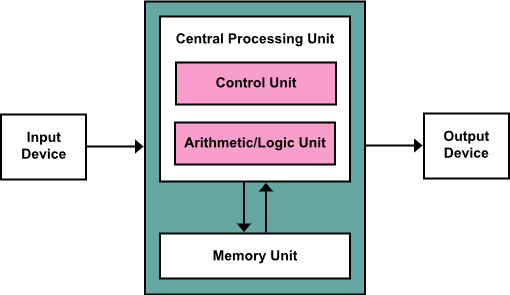
John von Neumann was also a proponent of education. He pushed for more math and science in schools to develop future leaders in the space.
IAS Computer – the original von Neumann machine
Built at the tail-end of the ENIAC, the Institute for Advance Study Computer (IAS) was the first von Neumann machine. The goal of the machine was to make computing more accessible to students, scientists, engineers, and the US military. The work on IAS led to the creation of a magnetic drum for memory storage. The device was implemented in the IBM 701 computer.
Within the decade following the ENIAC, von Neumann influenced computer design and architecture – considerably disrupting and antiquating each predecessor.
John von Neumann died in 1957, aged 53. He developed terminal cancer, possibly linked to his work with the Manhattan Project. Just before his death, von Neumann described the rapidity with which technology evolved, suggesting that singularity would occur in the future.
“The technology that is now developing and that will dominate the next decades is in conflict with traditional, and, in the main, momentarily still valid, geographical and political units and concepts. This is a maturing crisis of technology… The most hopeful answer is that the human species has been subjected to similar tests before and it seems to have a congenital ability to come through, after varying amounts of trouble.”
—von Neumann, 1955
The Technological Singularity by Murray Shanahan, (MIT Press, 2015), page 233
While the ENIAC owns the distinction of the world’s first digital general-use computer, it was not the first digital computer. That distinction belongs to Colossus.
We’ll dig into that disruption soon!
 Bird's Bytes