“When I was younger I could remember anything, whether it happened or not; but I am getting old, and soon I shall remember only the latter.”
Mark Twain, 1907
I attended a Dale Carnegie Skills for Success preview class last week. Very early into the session, the students were asked to commit a random sequence of objects to memory. The objects were arranged in an odd sequence. The sequence went something like this: Imagine Delicate Dinnerware with a No. 2 Pencil rising up from the center of the plate where a Jersey Cow balanced on the eraser, on the back of the cow sat Curious George (the monkey) with a small cut on his forehead. In George’s hand is a massive bag of ice. Perched on top of the ice bag is Marilyn Monroe who is holding a giant cruise ship. The ship is painted with an enormous Blue S on its bow. At the back of the cruise ship are fresh, new hams that are all wrapped in sheet music, the lyrics to Carry Me Back to Ole Virginny written on them. Sticking out of the hams is an upside down Empire State Building. Resting on the skyscraper’s base is another cruise ship, this time an enormous Red N is painted on its bow. Lastly, a pair of Island Red Hens dance at the stern.
The session only required 20 minutes for us to commit these objects to memory. As you can see, I have not forgotten them!
We all laughed at the absurdity of memorizing such an assortment of unrelated objects. But the last laugh of the memory was going to be on us…
Gustav’s Setting Device for Calculating Machines… and the Like!
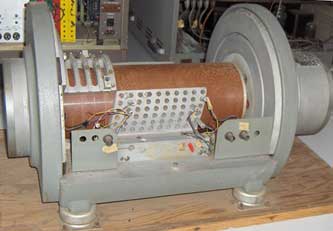
In 1929, Austrian super genius Gustav Tauschek invented the world’s first electronic storage device. Yes, Charles Babbage invented the analytical engine with storage by punch cards, but Babbage’s device was not digital. The patent granted to Tauschek for his “Setting Device for Calculating Machines and the Like” in 1932 featured only a simple drawing of the device. The device utilized a rotating metal drum which was coated with a ferromagnetic surface. The surface was imprinted by a series of stationary write heads. Another series of stationary read heads recognized the patterns imprinted on the drum. The patterns were no more than simple particle orientations, formed by altering the ferromagnetic material at that particular location. The heads read the magnetic orientations as 1 or 0. Tauschek’s first drum stored 62.6KB of data.
Microchips, Processors, and RAM
Robert Noyce invented the first integrated circuit in the late 1950’s. Integrated circuits replaced discrete transistors and are ubiquitous today. IC’s are found in EVERY electronic device manufactured. Noyce later founded the most formidable chip manufacturer in history – Intel. Little information is required to capture Intel’s impact on the global computer industry. He as recently been named the “Thomas Edison & Henry Ford” of modern computing. Yet only recently are historians aggregating Noyce’s contributions to the world.
‘Bob Noyce cannot be forgotten‘ as the biography, “The Man Behind the Microchip: Robert Noyce and the Invention of Silicon Valley” by Leslie Berlin strongly articulates.
Noyce’s inventions and companies drove the industry of microchips, RAM, and storage. His memory will certainly endure permanently.
Hard Disk Drives
IBM invented the modern Hard Disk Drives (HDD) in the late 1950’s. These drives captured and stored data on rotating magnetic drums and registers. Write heads performed the particle manipulations as the disks rotated underneath; Read heads interpreted the orientations of the particles, processing them in a logic registry.
HDD’s are still in use today with magnitudes more memory capabilities than IBM’s 350. Recent innovations relative to optical storage (binary strings encoded on composites and substrates) and Solid State Drives are quickly rendering HDDs a thing to remember.
Running out of Space?
A recent study by Yale suggests that the rare Earth metals used in manufacturing drives, chips, and processors may be drying up. A subsequent scientific journal digs very deeply into the question of “are we running out of space?” The conclusion is that we are not there yet. This does not prevent us from asking the questions though. What about the future of storage and memory? Will businesses rely on cloud storage because on-premise data storage becomes cost-prohibitive? What about personal computing? Will all the future devices emulate the iPad and Surface – dummy devices that only present while storage and compute occur elsewhere?
Saved by DNA?
Breakthrough technology enables data imprinting on and reading from strands of synthetically produced DNA. The technique generating binary storage requires that proteins supplant magnetic orientation or substrate modification.
The quantity of storage is doubling every year so we may need to rethink data consumption vs. storage as a function of digital asset planning. One thing is for certain though, DNA storage would eliminate any concern over rare Earth metals loss.

I have to ask the obvious question: “how different is DNA data storage from our own capabilities for memory?”
Random Memory, Accessed
The Dale Carnegie class finished with a unique exercise. The instructor asked for a volunteer and naturally I raised my hand. She asked if I knew the original 13 colonies. I rattled off a handful, but failed when I said Maine. She then asked if I remembered anything about the string of objects we committed to storage earlier in the session.
Needless to say, I know all 13 colonies AND the order in which they gained Statehood!
That is definitely a random memory, stored in my DNA, accessible at a moment’s notice for the rest of my life. And I won’t need digital storage to save it for me.
 Bird's Bytes