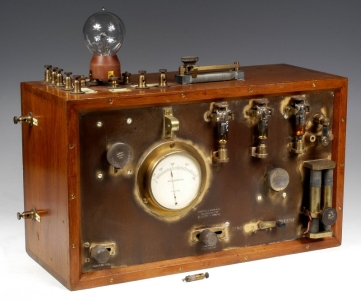
The other day I shouted across the office to a co-worker. I asked them about a production order and its status on the shop floor. They shouted back an answer. It was a super quick way to get and receive information. Yet as we all know, sometimes the spoken word does not suffice. Whether it be distance, the din of war, or even language barriers, immediate communication and the influence of messaging dramatically evolved over the past 150 years. Let’s take a look back at the core tools used for instant (relatively speaking) communication.
Télégraphie Chappe
The French optical telegraph emerged in the late 18th Century. Invented by Claude Chappe, the system utilized a country-wide network of relay towers. Each tower consisted of a mast and mechanical arms. An operator moved the arms into standardized positions. Each position represented a text or code. A sequence of codes or positions generated a full message. The source message originated on one tower and the nearest towers would then relay the exact messages to the next towers in their lines of sight. The sequence was repeated from tower to tower until the message arrived at its destination. The network was massive with over 500 stations covering the main trade routes of the country.
During this time, the French possessed an unparalleled advantage over their adversaries. Napoléon Bonaparte leveraged the technology to take over most of Continental Europe in the early part of the 19th Century. The semaphore messages relayed from Paris to Strasbourg, a distance of 445km, took 4 days on horseback, after the installation of the network, messages were delivered in 2 hours. Using the communication system, his armies knew the whereabouts of their opponents, transferred battlefield information across country, and called on reinforcements when needed. Their opponents were left standing around wondering how the French knew so much. The system was huge and far reaching, and not unlike Napoléon’s bombastic decisions to invade Russia and England spreading his armies thin, the optical telegraph met its demise quickly. The electric telegraph replaced it within the same generation.

Four Score and Fifty Thousand Miles
When the electric telegraph was first introduced to the United States by Samuel Morse, several European inventors were already experimenting with electric telegraphing in England and France. The European models required multiple wires. Morse developed a single line transmission system as well as a language to go with it. Morse’s invention was successfully utilized in the Washington D.C. area. His installation along the Baltimore & Ohio Railway connected two buildings 38 miles apart. The first Morse telegraph was sent and received in May, 1844. Between 1844 and 1860, a handful of companies installed over fifty thousand miles of telegraph line, over ten thousand telegraph operators and fourteen hundred telegraph stations across the North American Continent.
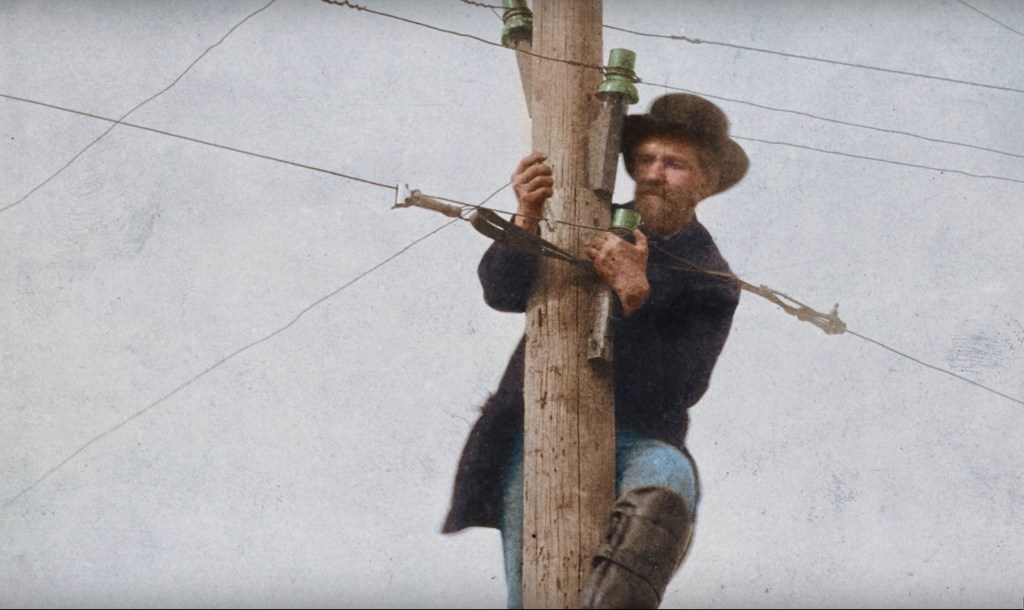
In 1861 the Civil War broke out.
Almost immediately, Abraham Lincoln established the U.S. Military Telegraph Corps. The civilian corps functioned to support the battlefield commanders of the Union Army. And during the war, “the President spent more time in the War Department telegraph office than any other place” (Lincoln in the Telegraph Office. David Homer Bates. 1907. The Confederacy did not focus their attention on establishing telegraph lines. Instead, they focused on tearing down the Union’s telegraph wires.
While the Union faced early setbacks at Manassas and Bull Run, the fearless support from the Telegraph Corps ensured that open lines of communication were always available to Washington. Over a short time, the Corps also established cyphers and codes to confuse and challenge the South. Being able to communicate with brief but succinct telegraphs across the vast reaches of the Union and then receive quick replies coupled with the South’s latency in setting up their own communications infrastructure gave Lincoln a substantial advantage in the Civil War. There is enough history to prove that the decision to form the Telegraph Corps probably won the war for the Union four years prior to the burning of Atlanta.
The telegraph remained a vital instrument of instant communication for decades. Western Union and AT&T made billions sending telegrams to family, friends, businesses, and loved ones from the 1890’s to the 1980’s. Allegedly, you can still send a telegram for about $10.
Titanic to Carpathia: We Require Immediate Assistance
1912, April 14, 10:41pm (EST) – The RMS Titanic radiotelegraphed for help. Four hours later, the unsinkable sank. 1,500 souls perished. And the Carpathia, arriving at 2:00am, rescued the remaining 770 survivors. But this is not a story about the Titanic. James Cameron nailed that. This is a story about Marconi’s Radio.
The Marconi Radio was the first wireless telegraph or radiotelegraph. Short bursts of Morse Code were transmitted through air instead of across wires. Used on the Titanic, the Marconi Radio transmitted wave after wave of distress signals to all who were listening. So new was the technology that its founder, Gugliemo Marconi had not yet opened a manufacturing facility for his radios. The Carpathia, and many other ships, received all of the radiotelegraphs transmitted by the Titanic, but most failed or could not respond to the most crucial message of all.
The neglect of responding forced International investigations and policies. Crew members testified about the radiotelegraphs sent to and from the Titanic. A BBC documentary was put together for the centennial of the disaster, capturing the decoded messages, reading them in English. Most of the radiotelegraphs are cordial but the distress calls are fascinating and haunting. Would a faster reaction from the Californian or Carpathia saved more lives? We may never know. What is known from the Titanic wreck is that technology enabled information to be transmitted anywhere, anytime for anyone listening.
Come Here, I Want to Talk to You
A single copper wire connected New York to San Francisco. In New York, Alexander Graham Bell sent his voice into the carrier. In San Francisco, an analog signal that was shot across the continent arrived to the receiver of Thomas Watson. There was not much to hear, mostly muffled buzzing and hums. Yet in 1915 it was the first transcontinental phone call.
Amplitude Modulation (AM) wireless transmission arrived simultaneously. It would be another 20 years before wired telephone calls were clear. And during those two decades, AM radio was the Bee’s Knees.
Wirelessly Connected to the Pinstripes
KDKA AM Radio in Pittsburgh, Pennsylvania broadcast a live baseball game between the hometown Pirates vs. their in-state rivals Philadelphia Phillies in 1921. It was this game which brought the ball park to the listener. “Baseball on the radio is language first and foremost.” Crack of the Bat: A History of Baseball on the Radio. James Walker, 2015. This language of the announcers, the fans in the stadium, the sound of the pitched ball slapping the catcher’s mitt, or the ball off the barrel instantly connected fans to their heroes. Close your eyes and you are already there.
Radios were cheap, baseball was slow and narrated. The two were a perfect match.
END OF PART ONE
NEXT UP in this two part series -> Radio, We Still Love You. Not You, Internet Trolls.
I believe in total transparency, very little of what I write is new or inciteful. The purpose is to show how rapidly technology changed during the last 200 hundred years – so much change occurred that the World now relies exclusively on data transfer to make it through everything, everyday. READ ON.
 Bird's Bytes