Do you own a Radio set?
1930 National Census

The 1930 census included for the first time a question regarding a consumer item. Respondents were asked whether they owned a “Radio set,” a luxury that had become increasingly common in the 1920s.
The radio was the first national mass medium. It linked every listener to news, sports, entertainment, comedians, political talk, and most of all, music. And of course it was free!
Not all nations celebrated the free programming on radio in the same manner as Americans. The 1930’s also brought about a war on truth.
Joseph Goebbels ensured that radios would deliver the Nazi message to Germany. Goebbels delivered the Reich’s messages through the Ministry of Public Enlightenment and Propaganda. In his first speech to reporters about mass media, Minister Goebbels said “One can fire at the opponent with machine guns until he recognizes the superiority of those who have the machine guns. That is the simplest way. One can also transform a nation through a revolution of the spirit, not destroying the opponent, but winning him over… We have not become a minister to be above the people, but rather we are now more than ever the servant of the people.” Goebbels was using radio, television, film, and newspapers to first connect with the people, and second to transform and mold them to the propaganda of the Nazi party.
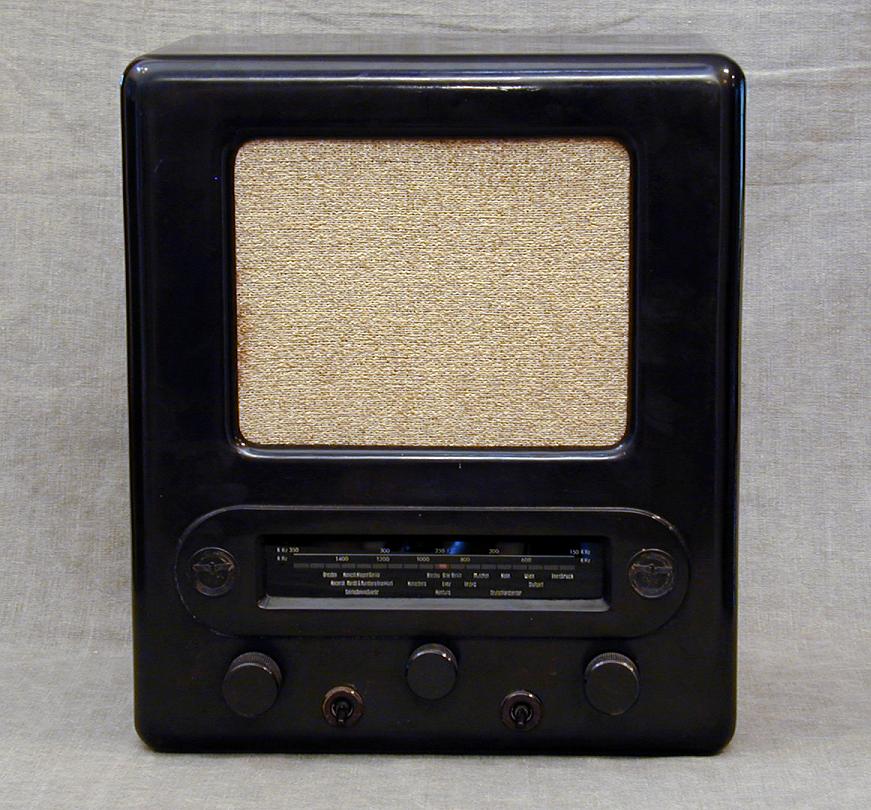
Not long after taking the lead role in the Ministry, Goebbels and the Nazi party disbanded all of Germany’s private radio and television stations and took ownership of their equipment to deliver their ‘cleansed’ content. The ministry also sold and distributed a cheap effective radio set called the Volksempfaenger for a mere 75 Reichsmarks. All German citizens afforded one, therefore all German citizens were tuned into to its programming. By the time Chancellor Hitler delivered his Enabling Act speech on the floor of the Reichstag on 23, March 1933, granting him unlimited authoritarian power over Germany, millions of citizens across the country were tuned in to hear their Dictator take control.

Goebbels gave Hitler the country by connecting the people to him through radio. With the people behind him, Hitler chartered the country into a decade of destruction. History knows the devastating consequences of Nazi Germany’s desire to rule the world.
Made for T.V.
American soldiers came home from the war. Families moved to the suburbs. Everyone bought a television. The late 1940’s through the 1960’s television programming entertained Americans from the comfort of their homes. Lucy led the way, followed by game shows, westerns, family comedies, crime dramas, live sports, soap operas, and the bane of all television watching for decades to come, commercials.
Televisions connected with people in ways that radio and telegrams could never: it was eye to eye. Viewers could see the faces, expressions, and body language of their presenters. The connections were visceral. People fell in love with the Beatles and Elvis because the rock and roll stars were playing for them, in their house!
Television definitely connected people with celebrities, athletes, and game show hosts. It also revealed the horrors and atrocities of war. The Vietnam War was the first televised war. While World War II film footage was highly edited and focused on morally supportive results, Vietnam was broadcast live.
The war tore America apart. Anti-war protestors saw the images of dead soldiers and marched in the streets. War supporters saw the images and accepted the losses as the price of freedom.
The National Archive claims that the Vietnam War so deeply divided America that its fracture remains to this day.
Radio on the Tube
As television gained prominence in American households, it didn’t leave its audio roots behind. The transition from radio to television was seamless for some radio personalities, who found a new home on the small screen. The late-night talk show format, pioneered by radio legends like Jack Benny and Eddie Cantor, made its way to television with hosts like Johnny Carson and Dick Cavett. These shows became a staple of American television, offering a mix of comedy, interviews, and cultural commentary. The transition from radio to TV not only preserved the essence of these shows but also elevated them to a visual medium, creating a more immersive experience for the audience.
The influence of radio on television was not confined to late-night programming. Daytime TV also witnessed a transformation with the introduction of talk shows that were once radio staples. Shows like “Maury Povich” and “Jerry Springer” brought the sensationalism of radio talk shows to a visual medium, captivating audiences with dramatic confrontations and emotional revelations. This shift from radio to television demonstrated the adaptability of the medium and its ability to evolve while retaining the essence of its predecessors.
The Internet Talkshow Revolution
Fast forward to the digital age, and the talk show format has found a new home on the internet. The rise of blogs, social media, and online personalities has given individuals a platform to host their own talk shows, reaching audiences globally. Podcasts, YouTube channels, and live streams have become the modern equivalent of daytime and nighttime TV talk shows, offering a diverse range of content from interviews to discussions on current events.
Online personalities like Joe Rogan, with his immensely popular “Joe Rogan Experience” podcast, have become the new-age talk show hosts, connecting with audiences on a more personal level. The democratization of content creation on the internet has allowed for a multitude of voices and perspectives to be heard, reflecting the diversity of opinions in today’s globalized world.
In a more recent development, Pat McAfee, known as “The Punter,” has successfully transitioned from his career in American football to become a prodigious internet talk show host. As a personal sidenote, I had the privilege of residing in Morgantown, WV during Pat’s time as a punter for the Mountaineers, witnessing his live performances on multiple occasions. Our paths even crossed at a house party hosted by my downstairs neighbors, where we shared a few beers.
The Pat McAfee Show, boasting over 2 million subscribers, is not only a testament to his success but also exemplifies the rapid growth of internet talk show influence. Notably, the show is simulcast on ESPN, underscoring its broad and expanding impact in the digital space.
Give rise to the social media accounts of Super Influencers, stars of the field and stage who parlayed their careers into online personas that help everyday citizens feel connected to them.
Welcome Nikkie de Jager!
Nikkie De Jager, widely known as NikkieTutorials, is a Dutch makeup artist, beauty vlogger, and YouTube sensation who has left an indelible mark on the beauty and cosmetics industry. Born on March 2, 1994, in Wageningen, Netherlands, Nikkie gained international recognition for her exceptional makeup skills, creative artistry, and engaging online presence. Her journey into the beauty world began at a young age, and she honed her talents through self-expression and experimentation.
NikkieTutorials rose to prominence on YouTube, where she started her channel in 2008. Her makeup tutorials quickly garnered attention for their precision, uniqueness, and vibrant energy. Nikkie became particularly celebrated for her transformative power, showcasing the artistry of makeup and its ability to empower individuals to express their true selves. Her openness about personal experiences, combined with her skilled application techniques, resonated with millions of viewers globally, turning her into a beloved figure in the beauty community. Her 20M Instagram followers show her influence!
One of Nikkie’s career-defining moments occurred in 2020 when she courageously came out as transgender in a heartfelt video titled “I’m Coming Out.” The video not only demonstrated her authenticity but also inspired countless individuals struggling with their identities. Nikkie’s openness about her journey fostered a sense of connection and community, reinforcing her role as an influential advocate for self-acceptance and inclusivity in the beauty world.
Beyond her YouTube success, NikkieTutorials has collaborated with major beauty brands, launched her own makeup collaborations, and has been recognized with numerous awards for her contributions to the beauty industry. With her charismatic personality, remarkable skills, and commitment to authenticity, Nikkie De Jager continues to be a driving force in reshaping beauty standards and inspiring a diverse and inclusive beauty landscape. As of 2022, her YouTube channel has 22M followers!
Golazo Ronaldo!
https://www.instagram.com/cristiano/
Cristiano Ronaldo, also known as Ronaldo, CR7, and affectionately called “The GOAT” (Greatest of All Time), has not only dominated the football scene but has also become a social media sensation. With an impressive track record as the highest-paid athlete according to Forbes in 2016-17 and 2023, it’s no surprise that he holds the top spot in the social media realm.
In 2021, Ronaldo celebrated crossing the 500 million followers milestone across various social platforms, and today, that number has grown to an estimated 3/4 of a billion followers. Over the course of his illustrious career with football powerhouses Manchester United, Real Madrid, and Juventus, Ronaldo’s star has shone brightly for three decades.
While fans initially flocked to Ronaldo’s social media accounts to witness his remarkable technique and jaw-dropping goals, there has been a shift in recent times. Beyond his professional prowess, followers are increasingly interested in glimpses of Ronaldo’s personal life. This has become a focal point where CR7 attracts the most attention.
Despite boasting half a billion followers on Instagram alone, it was the 2017 nude photo shoot and associated pictures that garnered widespread attention beyond the usual football circles. Ronaldo, along with his football clubs, has capitalized on this broader appeal, turning non-football viewership into a lucrative source of income by raking in millions through non-sport-related advertising.
Shoot it Dr!
Meanwhile, in the realm of gaming and online entertainment, another figure captivating the digital audience is none other than Twitch superstar Dr. DisRespect, also known as Guy Beahm. With his iconic mullet wig, tactical gear, and unmistakable persona, Dr. DisRespect has carved out a unique space in the gaming community. Known for his energetic and entertaining live streams, he has amassed a massive following on Twitch.
Dr. DisRespect’s rise to fame accelerated as he brought a theatrical flair to his gaming sessions, combining skillful gameplay with humor and showmanship. His commitment to maintaining his character both on and off the screen has contributed to the creation of a brand that extends beyond the gaming world.
As one of the most popular streamers on Twitch, Dr. DisRespect has cultivated a dedicated fan base that eagerly anticipates his streams and engages with his content. Beyond the gaming sphere, he has ventured into various collaborations, sponsorships, and even explored creating original content.
Much like Cristiano Ronaldo, Dr. DisRespect exemplifies the expanding influence of digital personalities and the ability to captivate audiences across diverse interests. Both figures, each in their respective fields, showcase the evolving landscape where traditional and digital media converge to create a global phenomenon of entertainment and engagement.
The Dark Side of Connectivity
In the realm of influential personalities, each Super Influencer—Nikkie De Jager, Cristiano Ronaldo, and Dr. DisRespect—wields a unique impact on their respective audiences. While Ronaldo epitomizes a polished image on and off the football field, NikkieTutorials embraces authenticity in the beauty world, and Dr. DisRespect navigates the gaming sphere with a blend of dark humor and intense personality. However, the consequences of their influence extend beyond their individual realms.
The polished image that Ronaldo maintains has made him a global icon, setting standards of success and professionalism. Similarly, Nikkie’s journey as a transgender woman and her commitment to authenticity challenge traditional beauty norms, encouraging self-expression and acceptance. Meanwhile, Dr. DisRespect’s online persona, characterized by intense rants and dark humor, raises questions about the potential harm of such behavior, especially in the context of internet trolls.
As these Super Influencers shape perceptions and behaviors, viewers, gamers, and fans face the choice of either rejecting or embracing the influence. Ronaldo’s followers may strive for success and professionalism, while Nikkie’s audience might find empowerment in embracing their true selves. However, the intense and potentially harmful aspects of Dr. DisRespect’s persona raise concerns about whether some may be influenced to engage in absurd or violent actions. The consequences of embracing or rejecting these influential behaviors highlight the broader impact that Super Influencers have on shaping societal norms and individual choices.
In the vast landscape of cyberspace, internet trolls have emerged as a disruptive force, spreading hate, misinformation, and toxicity. Unlike the carefully curated and regulated content of traditional media, the internet allows individuals to anonymously unleash vitriol without accountability. This dark side of connectivity stands in stark contrast to the genuine connections fostered by radio, television, and early internet communities.
2016 – The Lost Internet
The Internet is lost to a culture of hate.
Joel Stein August 2016
Once it was a geek with lofty ideals about the free flow of information. Now psychologists call this the online disinhibition effect, in which factors like anonymity, invisibility, a lack of authority and not communicating in real time strip away the mores society spent millenia building.
In 2016, Joel Stein penned an insightful article for Time magazine, shedding light on the pervasive issue of internet trolls and the disturbing culture of hate that was taking hold on the internet. Stein’s observations provide a broader context for understanding the concerns raised about influencers like Dr. DisRespect and the potential impact of their online personas.
In his article, Stein delves into the disturbing trend of internet trolling, where individuals engage in online harassment and provocation to incite reactions from others. The culture of hate he describes reflects the darker side of online interactions, where anonymity often emboldens individuals to express extreme views or engage in harmful behaviors without facing real-world consequences. The article underscores the challenges posed by this phenomenon, affecting not only individuals but also the overall tone and atmosphere of online spaces.
When examining influencers like Dr. DisRespect, whose intense rants and dark humor have garnered significant attention, it becomes crucial to consider how their online presence may contribute to or counteract the prevailing culture of internet trolls. Stein’s exploration of the loss of the internet to hate culture adds depth to the discussion, prompting us to reflect on the responsibility influencers bear in shaping online environments and the potential consequences of perpetuating or challenging the status quo. As we navigate the influence of Super Influencers, understanding the broader context of internet culture, as explored by Stein, becomes essential in addressing the multifaceted impact of online personas.
Whitney Phillips, author of “This Is Why We Can’t Have Nice Things: Mapping the Relationship between Online Trolling and Mainstream Culture,” delves into the intricate history and culture of online trolling, offering valuable insights into its evolution and its complex relationship with mainstream culture. Her work, often referred to as “A Brief History of Trolls,” becomes a pivotal addition to the Internet Trolls section of this paper.
Phillips thoroughly explores the origins of online trolling, tracing its roots back to the early days of online forums. By doing so, she illuminates the deep integration of trolling behavior into internet culture, shedding light on its historical development and evolution. This historical context, as outlined by Phillips, serves as a valuable complement to Joel Stein’s observations regarding the emergence of a culture of hate on the internet.
As we examine the influence of Super Influencers like Dr. DisRespect and navigate the consequences of their online personas, Phillips’ work becomes integral in understanding the broader dynamics of trolling behavior. Her insights provide a nuanced perspective on how trolling has shaped and been shaped by societal dynamics, emphasizing the intricate relationship between online subcultures and the broader cultural landscape. Incorporating Phillips’ research enriches the discussion, offering a comprehensive understanding of the multifaceted nature of internet trolling and its implications for online culture.
From Hate to Lies
The early days of internet trolling were characterized by provocative and disruptive behavior within online communities. However, this behavior has transformed into a more sinister manifestation—contributing to the spread of online misinformation. Trolls, once known for stirring controversy for their amusement, have weaponized their tactics to manipulate information, creating a significant challenge for online discourse.
This evolution is particularly evident in the current landscape of social media platforms. Individuals with trolling tendencies exploit the algorithms and the rapid dissemination capabilities of these platforms to amplify misleading narratives. The line between online trolling and deliberate disinformation has become increasingly blurred, raising concerns about the erosion of trust and the potential real-world consequences of misinformation.
To what extent can provocative online behavior contribute to the spread of misinformation, and how does this impact the broader online culture?
Since 2016, misinformation campaigns have driven a deepening divide between Americans. Take the Presidential election cycle when a deceitful conspiracy theory took hold and consequentially influenced voters. The pizzagate consipracy theory went viral on social media. Farmed by trolls and spread like wildfire, it alleged human trafficking and pedophilia. Without context and supporting evidence, readers latched on to the sensational un-news and redistributed the links and messages. https://en.wikipedia.org/wiki/Pizzagate_conspiracy_theory

In 2017, it was widely reported that the Russians interfered with democratic elections. Multiple independent investigations discovered that Russia was not only impacting Americans, but Germans and British citizens too. https://www.theguardian.com/world/2017/jan/09/germany-investigating-spread-fake-news-online-russia-election
The misinformation was intended to destabilize governments. And it succeeded. From 2016 – 2023, multiple neo-fascist groups emerged with fervor in the United States, Brazil, South Africa, and France. Even India experienced a rise of the populist far-right ideology. At its core, fascism intends to rule with racial supremacy using an authoritarian and anti-immigration position. It opposes social democracies and to an extent capitalism.
When trolls lean into self promotion, fascist ideologies, and misinformation while benefiting from the mass media available to them, uncertainties arise.
The Enduring Love for Radio
Despite the challenges posed by internet trolls and the ever-evolving landscape of media, radio remains a resilient and cherished medium. Its ability to create genuine connections, share stories, and provide a platform for diverse voices continues to resonate with audiences worldwide. While the internet may have changed the way we consume information and connect with others, the enduring love for radio stands as a testament to the timeless power of authentic communication.
In conclusion, as we reflect on the journey from radio waves to internet streams, it’s essential to recognize the transformative power of media in shaping our connections and influencing societal dynamics. While the internet has brought unprecedented connectivity, it also brings the responsibility to navigate through the noise and uphold the values of genuine communication that have been the heart of mediums like radio for decades.
THIS ARTICLE IS A CONTINUATION: https://birdsbytes.com/2020/01/31/immediate-interruptions-semaphore-to-baseball-score
 Bird's Bytes